canon in d piano sheet pdf
Canon in D Piano Sheet PDF: A Comprehensive Guide (Updated 03/06/2026)
Discover readily available, free and paid Canon in D piano sheet music PDFs, catering to all skill levels, from beginner arrangements to advanced performances.
What is Canon in D?
Canon in D, formally titled Canon in D major, is a timeless piece of Baroque music composed by Johann Pachelbel around 1680. Originally written for three violins and basso continuo, its enduring popularity stems from its beautiful, cyclical harmonic progression. Today, it’s frequently adapted for various instruments, most notably the piano.
The piece’s structure revolves around a repeating bassline – the “ground bass” – over which melodic variations unfold. This simple yet elegant framework lends itself beautifully to piano arrangements, making it accessible to a wide range of pianists.
Finding Canon in D piano sheet music PDFs is remarkably easy due to its widespread appeal. Numerous online resources offer both free and paid versions, catering to different skill levels and arrangement preferences. Its recognizable melody and harmonic structure make it a beloved choice for learning and performance.
Historical Context of Pachelbel’s Canon
Johann Pachelbel, a German composer of the Baroque period, created Canon in D around 1680, though its initial fame was limited. It wasn’t widely circulated during his lifetime and remained relatively obscure for centuries. The piece’s resurgence began in the 20th century, fueled by its use in popular culture and its inherent musical appeal.
Interestingly, the original manuscript lacked a title, and its current name is a later attribution. The composition likely served as a pedagogical exercise, demonstrating contrapuntal techniques to Pachelbel’s students.
The availability of Canon in D piano sheet music PDFs today reflects its modern prominence. Its journey from a relatively unknown Baroque piece to a globally recognized melody highlights the enduring power of music and the accessibility afforded by digital sheet music distribution.
Why is Canon in D Popular for Piano?
Canon in D’s enduring popularity on the piano stems from its beautiful, calming melody and relatively simple harmonic structure. The repeating chord progression is accessible to pianists of varying skill levels, making it a rewarding piece to learn. The availability of numerous Canon in D piano sheet music PDFs, ranging from easy beginner arrangements to complex interpretations, further contributes to its appeal.
Its recognizable tune resonates with a broad audience, and the piece offers opportunities for expressive playing and dynamic control.
The piece’s inherent elegance and emotional depth, combined with the convenience of downloadable sheet music, solidify its position as a staple in the piano repertoire, enjoyed by both students and seasoned performers alike.
Finding Canon in D Piano Sheet Music PDFs
Explore a vast online landscape for Canon in D piano sheet music PDFs, encompassing both complimentary resources and affordable options like BudgetBooks.
Free Sheet Music Sources
Numerous online platforms offer free Canon in D piano sheet music PDFs, providing accessible options for musicians of all levels. 8notes.com stands out as a prominent resource, boasting a massive community of musicians and over a million digital sheet music options. This platform allows users to share, download, and print sheet music freely, including various arrangements of Pachelbel’s Canon.
Beginners will appreciate the availability of abridged arrangements specifically designed for easier playability. These simplified versions maintain the essence of the piece while reducing complexity. However, it’s crucial to exercise caution when downloading from free sources, ensuring the quality and accuracy of the transcription. Always preview the sheet music before committing to a print to avoid errors or incomplete arrangements. Exploring different websites can yield diverse interpretations and arrangements, allowing you to find a version that suits your playing style and skill level perfectly.
Paid Sheet Music Options & BudgetBooks
While free resources abound, investing in paid Canon in D piano sheet music PDFs often guarantees higher quality transcriptions and more comprehensive arrangements. Several reputable music retailers offer meticulously crafted sheet music, ensuring accuracy and clarity. These options frequently include detailed fingerings and dynamic markings, enhancing the learning experience.
The BudgetBooks series presents an attractive alternative for musicians seeking affordable sheet music. Covering a broad spectrum of genres, from classical masterpieces to contemporary pop hits, BudgetBooks provides unbeatable prices without compromising quality. This series is ideal for expanding your repertoire without straining your budget. Paid options often feature professionally edited scores, eliminating potential errors found in some free versions. Consider exploring these avenues for a more polished and reliable musical experience, supporting composers and publishers in the process.
Sheet Music Difficulty Levels: Beginner to Advanced
Canon in D piano sheet music PDFs are available across a wide spectrum of difficulty levels, catering to pianists of all abilities. Beginner arrangements typically simplify the harmonic structure and melodic lines, focusing on single-note melodies and basic chord progressions. These versions often omit complex ornamentation and prioritize readability for novice players.
Intermediate arrangements introduce more intricate harmonies, incorporating broken chords and slightly more challenging rhythms. Advanced arrangements, however, present the full complexity of Pachelbel’s Canon, demanding a strong technical foundation and musical understanding. These scores may include elaborate embellishments, complex voicing, and demanding pedal work. Choosing the appropriate level is crucial for a rewarding learning experience; starting with an easier arrangement builds confidence and gradually introduces challenges, fostering progress and enjoyment.
Understanding the Sheet Music
Decoding the Canon in D piano score requires familiarity with key signatures, time signatures, and reading both treble and bass clef notations effectively.
Key Signature and Time Signature
Canon in D is predominantly written in the key of D major, meaning the sheet music will display two sharps – F# and C# – in its key signature. Recognizing this immediately informs you about the notes that will be altered throughout the piece. Understanding the key signature is crucial for accurate reading and performance.
The time signature is typically 3/4, indicating three quarter notes per measure. This creates the characteristic flowing, waltz-like feel of the Canon. Counting in groups of three is essential for maintaining the correct rhythm and phrasing. Beginner pianists should focus on internalizing this 3/4 time feel before attempting more complex arrangements.
Successfully identifying these foundational elements – the key of D major and the 3/4 time signature – unlocks a deeper comprehension of the sheet music and facilitates a more confident and musical interpretation of Pachelbel’s masterpiece.
Reading the Piano Score: Treble and Bass Clef
Canon in D piano sheet music utilizes both treble and bass clefs, essential for dividing the melodic and harmonic components. The treble clef, typically for the right hand, displays higher-pitched notes, often containing the recognizable Canon melody. Familiarity with note positions on the treble clef staff is paramount.
Conversely, the bass clef, generally for the left hand, presents lower-pitched notes forming the harmonic foundation – the repeating chord progression. Understanding bass clef note reading is vital for accurately playing the accompaniment.

Beginner arrangements may simplify this by focusing primarily on the treble clef. However, progressing to more complete versions requires proficiency in reading both. Practice identifying notes in both clefs independently, then combine them to play the complete score, ensuring a balanced and harmonious sound.
Chord Progression Analysis
Canon in D’s enduring appeal stems from its simple yet elegant chord progression. The piece is fundamentally built upon three chords: D major, A major, and B minor – a repeating sequence that creates a mesmerizing harmonic foundation. Analyzing this progression within the piano sheet music PDF reveals its cyclical nature.
Understanding the Roman numeral analysis (I-V-vi) clarifies the harmonic function of each chord. The consistent repetition, with slight variations in voicing, builds emotional depth. Recognizing these chords allows pianists to anticipate harmonic changes and improve their performance.
Many arrangements showcase inversions and embellishments of these core chords. Studying these variations within the sheet music enhances musical interpretation and provides insight into Pachelbel’s compositional technique.
Types of Canon in D Piano Arrangements
Explore diverse Canon in D piano arrangements, including full, abridged, solo, and duet versions, readily available as PDF sheet music for varied skill levels.
Full Canon vs. Abridged Arrangements
When considering Canon in D piano sheet music, a key distinction lies between full and abridged arrangements. The complete canon, as originally composed by Johann Pachelbel, is quite lengthy and features repeating sections – a characteristic of its canonic structure. Full arrangements faithfully reproduce this entirety, presenting a substantial undertaking for pianists.
However, many simplified versions, termed abridged arrangements, exist, particularly aimed at beginner and intermediate players. These condense the piece, often omitting repetitions or sections to create a more manageable length. An abridged arrangement of Canon in D, as found on platforms like 8notes.com, provides a quicker path to learning the core harmonic and melodic ideas.
Choosing between the two depends on your skill level and goals. Full arrangements offer a complete musical experience, while abridged versions prioritize accessibility and quicker learning. Both are valuable options when exploring this iconic composition.
Solo Piano Arrangements
Solo piano arrangements of Canon in D are the most common format encountered when searching for sheet music PDFs. These arrangements task a single pianist with interpreting all the harmonic and melodic layers originally intended for a string ensemble. Consequently, they often involve adapting the interwoven lines into a playable texture for two hands.
The complexity of solo arrangements varies significantly. Beginner-friendly versions simplify the harmonies and rhythms, focusing on the essential melody and chord progression. More advanced arrangements attempt to capture the richness of the original by incorporating fuller chords, arpeggios, and countermelodies.
Many online resources and sheet music providers offer a diverse range of solo piano arrangements, catering to different skill levels. Whether you’re a novice or an experienced pianist, a suitable solo arrangement of Pachelbel’s Canon is readily available for download and practice.
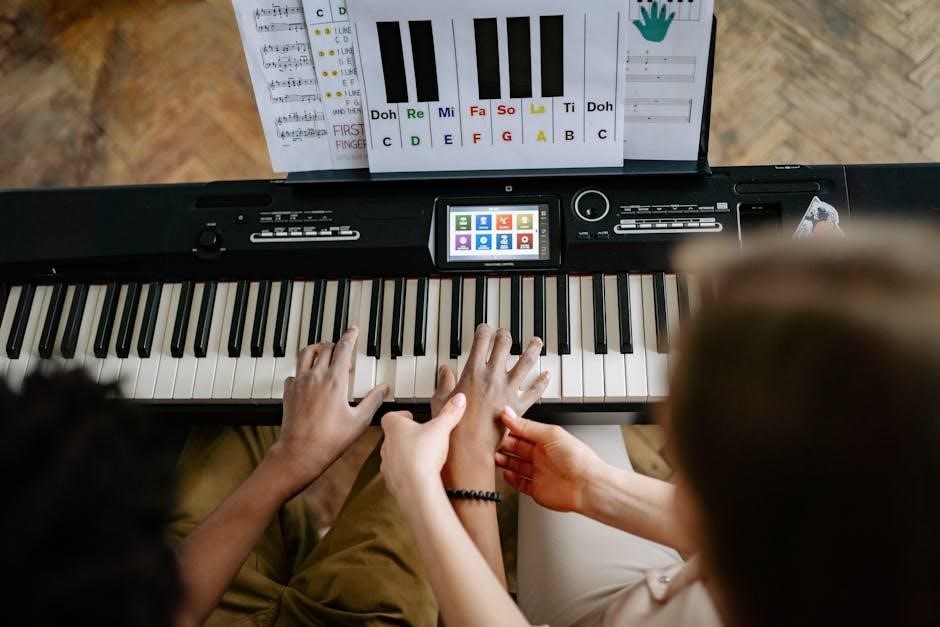
Arrangements for Piano Duet
Piano duet arrangements of Canon in D offer a collaborative and enriching musical experience. These arrangements divide the original composition between two pianists, allowing for a more complete realization of Pachelbel’s intricate harmonies and melodic lines. Typically, one pianist handles the higher register and melodic content, while the other focuses on the bass line and harmonic foundation;
Duet arrangements are particularly beneficial for students learning ensemble playing and sight-reading skills. They provide an opportunity to develop coordination, listening skills, and musical sensitivity. The shared workload can also make the piece more accessible than a challenging solo arrangement.
Finding suitable duet arrangements requires searching specifically for “piano duet” or “four-hand” versions of Canon in D. Several websites and sheet music retailers offer these arrangements, often categorized by difficulty level to suit various skill combinations.
Learning and Practicing Canon in D
Mastering Canon in D requires consistent practice, focusing on accurate rhythm, clear articulation, and a sensitive interpretation of this timeless musical masterpiece.
Tips for Beginner Pianists
Embarking on Canon in D as a beginner pianist is wonderfully achievable, especially with abridged arrangements designed for simpler playing. Start by mastering the right-hand melody slowly, focusing on accuracy before speed.
Utilize online tutorials and lessons to break down the piece into manageable sections. Pay close attention to finger placement and practice each hand separately before combining them.
Don’t be afraid to simplify further by playing only the chords initially, getting comfortable with the harmonic progression.

Consistent, short practice sessions are more effective than infrequent, lengthy ones.
Remember to listen to recordings of Canon in D frequently to internalize the phrasing and overall musicality.
Focus on smooth transitions between chords and maintain a steady tempo.
Celebrate small victories and enjoy the process of learning this beautiful piece!
Techniques for Intermediate Players
Intermediate pianists tackling Canon in D can refine their technique by focusing on voicing and dynamics. Explore full arrangements, paying attention to the interplay between the melody and the underlying harmonic structure.
Practice arpeggiating the chords to create a fuller, more textured sound. Work on achieving a legato touch, ensuring smooth connections between notes.
Experiment with subtle rubato to add expressiveness and musicality. Analyze the chord progression to understand the harmonic function of each chord and its relationship to the overall key.
Focus on developing independence between the hands, allowing the left hand to maintain a consistent bass line while the right hand embellishes the melody.
Utilize sheet music annotations to mark phrasing and dynamic changes.
Record yourself playing and critically evaluate your performance.
Advanced Performance Considerations
Advanced pianists performing Canon in D should prioritize nuanced interpretation and technical mastery. Explore complex arrangements, focusing on voicing, pedaling, and articulation to bring out the piece’s emotional depth.
Master the art of subtle dynamic shading and phrasing, creating a captivating and expressive performance. Delve into harmonic analysis, understanding the underlying chord progressions and their impact on the overall musical structure.
Experiment with ornamentation and improvisation, adding personal flair while remaining faithful to the original composition.
Refine your pedaling technique to create a seamless and resonant sound.
Consider performing from memory to enhance your connection with the music.
Study recordings of renowned pianists to gain inspiration and refine your interpretation.

Printing and Using PDF Sheet Music
Ensure optimal print quality and appropriate paper size for clear readability of your Canon in D piano sheet music PDF, respecting copyright laws.
PDF Editing and Annotation
Digital sheet music in PDF format offers fantastic flexibility for learning Canon in D on the piano. Many PDF readers allow for direct annotation, enabling you to mark fingerings, dynamics, and phrasing directly onto the sheet music. Highlighting important sections or chord changes can significantly aid memorization and understanding.
Furthermore, you can utilize PDF editing software to adjust the appearance, though be mindful of altering the musical notation itself. Adding notes to remind yourself of practice goals or difficult passages is incredibly helpful. Consider using different colored highlights for various musical elements – for example, blue for dynamics and green for fingerings.
Experiment with features like adding text boxes for reminders or drawing shapes to emphasize specific musical phrases. This personalized approach transforms a static PDF into a dynamic learning tool, tailored to your individual needs and progress with Pachelbel’s Canon.
Paper Size and Print Quality
When printing your Canon in D piano sheet music PDF, selecting the correct paper size is crucial for readability. Standard letter size (8.5 x 11 inches) generally works well, but A4 paper is also suitable. Ensure your printer settings match the paper size to avoid cropping or distortion of the musical notation.
Print quality significantly impacts the clarity of the sheet music. Opt for a higher DPI (dots per inch) setting – at least 300 DPI – for sharp lines and legible notes. Using quality printer paper prevents ink bleed and enhances the overall visual experience. Consider using thicker paper stock for durability, especially if you anticipate frequent use.
A test print is always recommended to verify the layout and clarity before printing the entire score. Adjust printer settings as needed to achieve optimal results, ensuring a comfortable and effective learning experience.
Legality of Downloading and Printing Sheet Music
Navigating the legality of downloading and printing Canon in D piano sheet music PDFs requires careful consideration. Downloading from reputable sources offering free sheet music, like 8notes.com, is generally permissible, as they often operate with composer permissions or utilize public domain works. However, always check the website’s terms of use.
Printing sheet music for personal use is typically legal, but distributing copies or using it for commercial purposes without permission is a copyright violation. Purchasing sheet music from authorized retailers, such as BudgetBooks, guarantees legal access and supports the composer and publisher.
Be cautious of websites offering copyrighted sheet music for free without proper licensing. Respecting copyright laws ensures continued access to musical resources for all musicians.
Resources for Learning Canon in D
Explore online tutorials, lessons, and vibrant sheet music communities like 8notes.com, alongside insightful analyses to enhance your Canon in D performance.
Online Tutorials and Lessons
Numerous online platforms offer comprehensive tutorials specifically designed to guide pianists through learning Canon in D. These resources frequently utilize the readily available PDF sheet music, breaking down the piece into manageable sections. Many lessons focus on proper fingering, rhythm, and dynamics, catering to various skill levels.
YouTube is a treasure trove of free tutorials, with many pianists demonstrating different approaches to the piece. Websites dedicated to music education often provide structured courses, sometimes with a subscription fee, offering personalized feedback and progress tracking. These lessons often complement the downloaded PDF sheet music, providing visual and auditory learning aids.
Beginners can benefit from tutorials that simplify the chord progression and melody, while more advanced players can explore interpretations focusing on ornamentation and expressive phrasing. Utilizing these online resources alongside the PDF sheet music accelerates the learning process and fosters a deeper understanding of Pachelbel’s masterpiece.
Sheet Music Communities and Forums (8notes.com)
Online communities like 8notes.com serve as invaluable hubs for musicians seeking Canon in D piano sheet music and collaborative learning. These platforms host a vast library of user-submitted arrangements, including various difficulty levels and stylistic interpretations of the PDF sheet music.
Forums within these communities allow pianists to exchange tips, ask questions, and share their progress while learning the piece. Users often discuss specific challenges encountered while interpreting the sheet music, offering solutions and alternative approaches. 8notes.com, in particular, provides a space for feedback on arrangements and encourages constructive criticism.
Access to diverse arrangements, coupled with the support of fellow musicians, enhances the learning experience. These communities foster a collaborative environment where pianists can refine their skills and deepen their appreciation for Pachelbel’s iconic composition, utilizing the readily available PDF resources.
Analysis of the Work for Performance
A thorough analysis of Canon in D, beyond simply reading the piano sheet music PDF, is crucial for a compelling performance. Understanding the harmonic progression – built upon a repeating chord sequence – reveals the piece’s underlying structure and allows for nuanced phrasing.
Focus on the interplay between the melodic lines; the canon itself is a conversation between voices. Recognizing this contrapuntal texture informs dynamic shaping and voicing choices. Studying the arrangement’s specific adaptation for piano, whether full or abridged, highlights the arranger’s interpretation.
Consider the emotional arc of the piece, building from a serene opening to a more expressive climax. This understanding, combined with technical proficiency derived from the PDF sheet music, elevates the performance beyond mere note-playing, conveying the timeless beauty of Pachelbel’s masterpiece.